

The Uganda Health Professions Assessment Board on Friday released results of the second national assessment series conducted under the newly enacted Technical Vocational Education and Training (TVET) Act, 2025, covering more than 100,000 candidates across accredited health training centres.
The assessment, conducted from December 1 to 12, 2025, took place at 215 accredited Health TVET assessment centres with an increase of 15 centres or 7 percent compared to the previous series. The exercise involved regulators, professional councils, health employers, TVET providers, security personnel and other stakeholders.
A total of 100,272 candidates participated in the second series. Of these, 81,230 (81 percent) were continuing candidates whose results will be issued to institutions on March 9, 2026, while 19,042 (18.9 percent) were final-semester candidates whose results were released to the public.
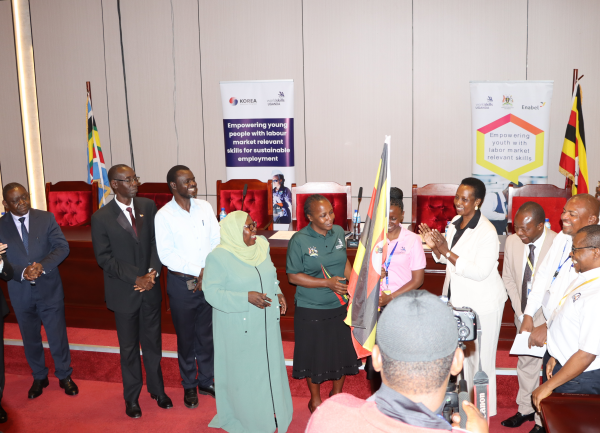
The First Lady and Minister of Education and Sports, Janet Kataaha Museveni, said the assessment reflects progress in strengthening regulation and quality assurance within health training institutions.
“The release of these results under the new regulatory framework demonstrates our commitment to ensuring that health trainees are assessed against clear competencies and standards that align with labour market demands,” she said.
The Minister added that increased enrolment and improved performance signal growth in the sector and contribute to addressing unemployment while strengthening the national health workforce. She urged successful candidates to treat their profession as a calling and to uphold professional ethics in service delivery.
Among the final-semester candidates, 13,665 (71.8 percent) were enrolled in certificate programmes and 5,377 (28.2 percent) were in diploma programmes. Certificate programmes continue to attract higher enrolment compared to diploma programmes, with eight certificate programmes accounting for the majority of trainees.
Female candidates accounted for 12,989 (68.2 percent) while male candidates were 6,053 (31.6 percent), reflecting continued female dominance in enrolment. However, the board observed a growing trend of male candidates registering for Diploma in Nursing Direct and Certificate in Nursing programmes.
Performance of Certificate Candidates
Out of 13,665 certificate candidates, 13,089 passed, representing a pass rate of 95.8 percent.
Performance breakdown shows that 2,469 candidates (17.6 percent) passed at distinction level, 9,998 (73.2 percent) at credit level, and 622 (4.6 percent) at pass level.
Of the 5,377 diploma candidates, 4,469 (83.2 percent) passed.
Among them, 188 candidates (3.5 percent) passed at distinction level, 3,600 (67 percent) at credit level, and 681 (12.7 percent) at pass level.
The Executive Secretary of the board, Hellen Mukakarisa Kataratambi, said the assessment was conducted in compliance with the new TVET Act, and involved key stakeholders to ensure credibility and transparency.
“This is the second national assessment guided by the TVET Act No. 3 of 2025. The process involved regulators, professional councils, employers and training providers to guarantee quality assurance and integrity in the examination system,” she said.
She further noted that the board assessed the first cohort of candidates for the Advanced Diploma in Critical Care Nursing and the Advanced Diploma in Emergency Care Nursing, programmes aligned to competence-based curriculum.
Hellen also reported that the final cohort for the Certificate in Comprehensive Nursing programme was assessed and successfully passed, marking the full phase-out of the programme in line with Ministry of Health recommendations.
She added that enrolment in the Diploma in Paediatrics and Child Health Nursing programme increased by 85.7 percent following tuition scholarship support, while Advanced Diploma programmes in Public Health Nursing and Palliative Care Nursing also benefited from scholarships.