

The Belgian Ambassador to Uganda, H.E Hugues Chantry has urged the Ugandan government to scale up investment in skills development as a strategic measure to combat youth unemployment.
Speaking during the International Day of Education post-event and World Youth Skills Day high-level policy dialogue in Kampala on Tuesday, Ambassador Chantry emphasized that equipping young people with practical and relevant skills is key to unlocking their potential and driving sustainable economic growth.
“We encourage the government of Uganda to keep on investing in human capital, and in education and skills development in particular,” he said.
Uganda concurs that investment in human capital, and skills development especially in young people, is very key to realising the country’s development ambitions.
Each year, over 400,000 young Ugandans enter the labor market, and yet most are unable to find decent employment. At the same time, some critical sectors such as construction, agriculture, tourism, energy and ICT continue to face a shortage of skilled labor.
This mismatch between training and market demand is both a challenge and an opportunity to bridge this gap.
Recently, President Yoweri Museveni assented to the TVET Act 2025 to equip students with skills that are required in the fast-evolving job market.
Some of the priority areas in Uganda that have for decades received funding from the Belgian government through its development agency, Enabel, include; secondary education, skills development and Technical Vocational Educational Education and Training (TVET).
“Our objective is that young people acquire useful and marketable skills that will help them find decent jobs or entrepreneurship opportunities in all kinds of activity sectors, but especially in tourism and sustainable and green agriculture. Enabel provides its expertise to national teacher colleges and TVET providers to enhance their capacity and to develop their learning materials,” said Ambassador Chantry.
To solve the challenge of unemployment that has heavily affected the country’s young population, Uganda must transition from a supply driven education model to a demand driven skills ecosystem.
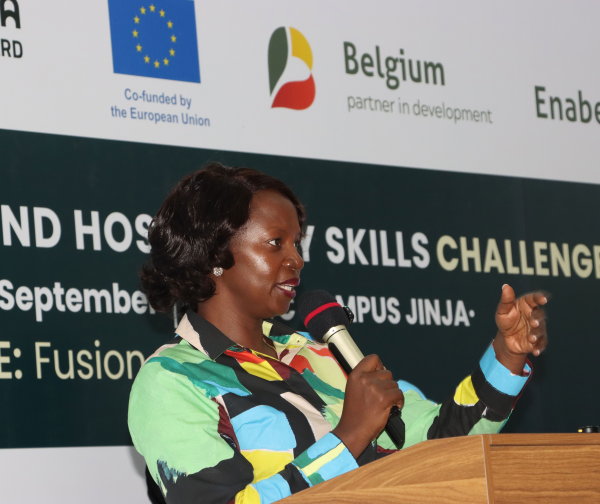
The Chairperson of the newly established TVET Council, Allen Kagina said that an inclusive TVET system is not just desirable, but an imperative for national competitiveness and resilience.
The establishment of the TVET Council and the ongoing formation of the Secretariat, Kagina said, provide a platform for systemic transformation.
“However, the focus must now shift to full implementation, ensuring that policies translate into outcomes at training institutions, in industry and within communities,” Kagina said.
Kagina said that to make TVET a true engine of socio economic transformation, the country must focus on institutional strengthening, labor market alignment, work based learning, modernization of infrastructure, inclusion and equity and sustainable financing.
“These focus areas must be pursued with consistency, professionalism and must be result oriented,”
Kagina reiterated that a transformed TVET system must be employer-led.
“This means that industry participates actively in curriculum design; this means that industry hosts trainees in workplace environments; this means that industry certifies skills aligned with our goals; and industry provides feedback on graduate readiness. That is how we will know that we are meeting the labor market demands. Government will facilitate this collaboration through policy incentives and a regulatory environment that promotes investment in skills. TVET must also prepare learners for a changing world of work. TVET must promote digital and sector specific technologies, innovations and entrepreneurship, soft skills such as communication, teamwork and leadership and blended learning and simulation platforms,” Kagina said.
“One of the things that I’m learning most recently is that when investors come into our country, they don’t ask for many things, including the National Ugandan investors. They ask for four main things; affordable financing; they are looking for skilled labor; stable energy; and tax incentives, but mainly skilled labor.”
TVET, Kagina said, is a driver of social economic transformation, adding that this transformation is not achievable without a skilled and adaptable workforce.
The potential of TVET lies in its direct link to the real economy. It prepares learners, not just for employment, but for enterprise, it supports inclusive growth by offering accessible and relevant pathways for diverse populations.
“The World Youth Skills Day is a powerful reminder of the urgent need to equip our youth with future-ready, value-driven skills,” Kagina said.