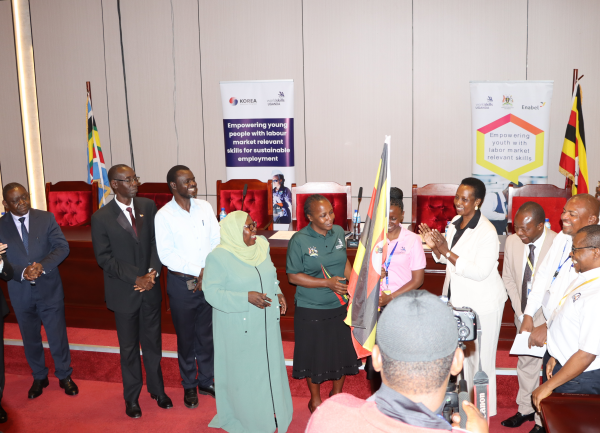


WorldSkills Uganda (WSU) has signed a Memorandum of Understanding (MoU) with the Kampala Capacity Development Institute (KCDI) to strengthen the quality of technical and vocational skills delivery, deepening industry involvement in Technical and Vocational Education and Training (TVET).
The partnership brings together two institutions with a shared interest in closing the gap between what TVET institutions teach and what employers actually need.
The collaboration looks beyond the classroom to strengthen the entire skills ecosystem, covering everything from the quality of skills delivery and curriculum review to support for trainers and trainees, the promotion of industry-relevant skills, increased youth participation in TVET, and structured opportunities for benchmarking through skills competitions.

The partnership creates opportunities for joint training, research, resource mobilisation, industrial training, innovation, networking and stronger connections between TVET institutions and industry.
An industry-led approach to skills training is a realistic path to producing graduates who are actually employable, since TVET institutions exist specifically to prepare young people for the world of work, and employers are best positioned to define what that work now requires.
TVET should be industry-led with the world of work involved in skills development because young people in TVET institutions are trained for the world of work, and it is employers who best understand the kind of skills they need.

Uganda needs skills that are calibrated to industry standards, competitive on the global stage, and capable of generating real economic value.
WHY EMPLOYER INVOLVEMENT MATTERS
Uganda’s TVET sub-sector has for decades struggled with an image problem, frequently regarded by parents and learners as a fallback option for those who do not qualify for university rather than a credible pathway to a career.
That perception problem exists alongside a more structural one: a persistent mismatch between the skills produced by training institutions and the skills employers say they actually need. Industry players in construction, manufacturing, hospitality, agro-processing and the digital economy have long complained that graduates arrive with theoretical knowledge but limited hands-on competence in the specific tools, standards and workflows used on the job.

Bringing employers directly into curriculum design, trainer support and student assessment is the mechanism through which that gap is meant to close. When industry sits at the table from the start, training content can be updated in step with changing technology and workplace practice, rather than lagging years behind it.
Skills competitions, of the kind WSU already runs domestically and feeds into regionally through WorldSkills Africa and internationally through WorldSkills International, serve a similar benchmarking function. They allow trainees and trainers to measure Ugandan standards against those applied elsewhere on the continent and across the world.